


In this edition, we explore the origins and evolution of Cursor, the AI-native code editor that rapidly reshaped how software is built. What began as an experimental project among four MIT graduates became one of the fastest-scaling companies in the AI tooling wave which is redefining developer workflows and setting new expectations for human–AI collaboration in software engineering.
Cursor’s journey is a story of technical conviction, sharp pivots, and disciplined execution at exactly the right moment in the AI cycle. It is also a reminder that transformative companies often emerge not from grand initial visions, but from founders obsessively solving a problem they understand deeply.
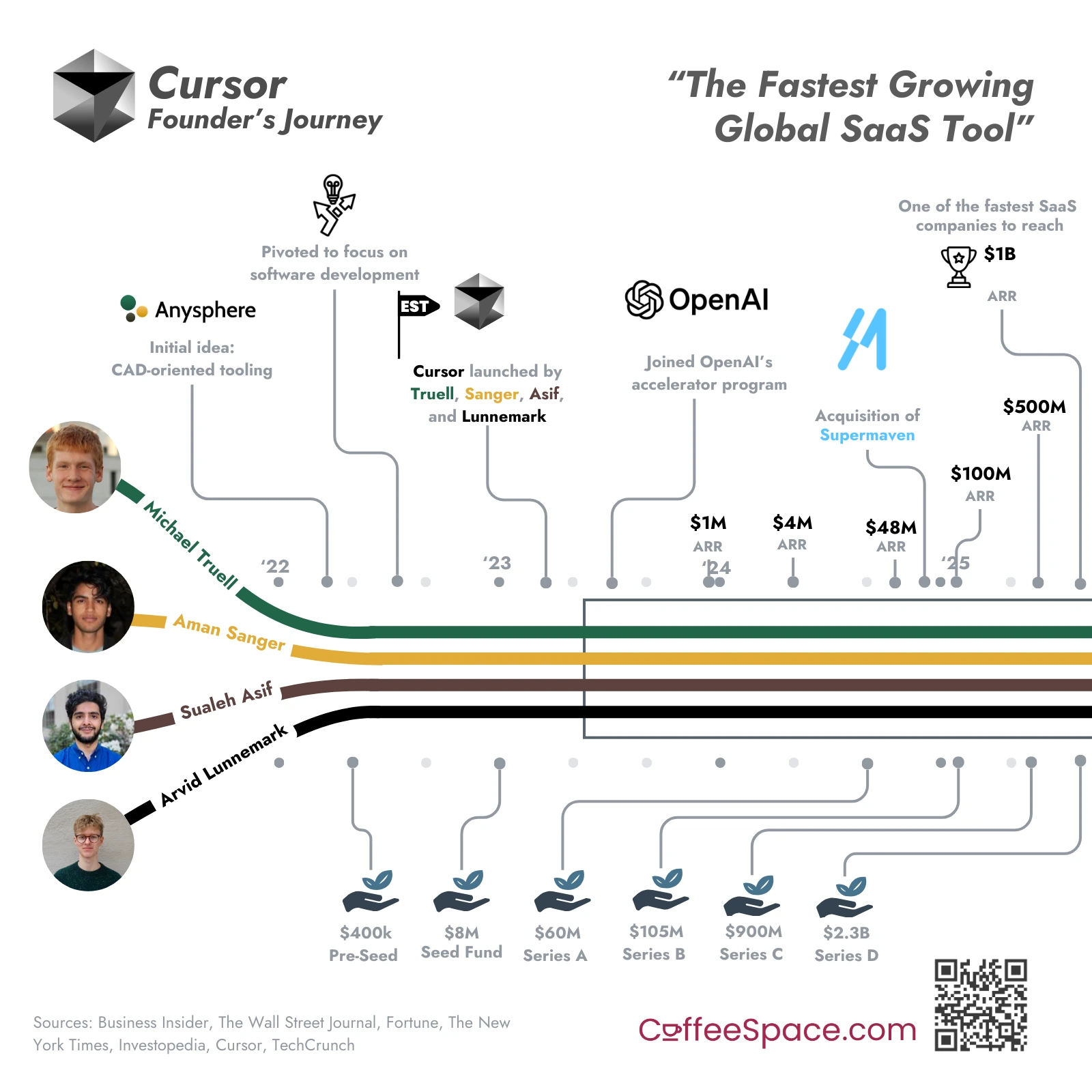
The MIT Roots: Where Cursor Began (2022)
Cursor’s story begins not in a Silicon Valley accelerator or a polished startup studio, but within the intellectually dense environment of the Massachusetts Institute of Technology. Michael Truell, Sualeh Asif, Arvid Lunnemark, and Aman Sanger met as students and collaborators, each shaped by MIT’s culture of experimentation and rigorous problem‑solving.
In 2022, the four founders incorporated Anysphere, the company that would later produce Cursor. Their early work focused on applying artificial intelligence to complex engineering problems, including mechanical design and analysis. At the time, large language models were improving quickly, but their applications remained fragmented and often superficial.
As the founders explored where AI could create the most leverage, one domain stood out clearly: software development. Despite the emergence of tools like GitHub Copilot, coding still felt fundamentally manual. Developers wrote most logic themselves, navigated sprawling codebases unaided, and spent countless hours debugging and refactoring. Existing AI tools helped with snippets, but they did not understand projects as systems.
That gap became the spark. The founders realized the opportunity was not to build another AI assistant, but to rethink the code editor itself.
Reimagining the Code Editor: The Cursor Vision
From the outset, Cursor was conceived as an AI-native editor rather than an add-on or plugin. Instead of layering AI on top of existing workflows, the team chose to fork a familiar editor and embed intelligence directly into its core. This decision was both technical and philosophical.
By operating at the editor level, Cursor could observe the full structure of a codebase — files, dependencies, symbols, and developer intent, enabling a qualitatively different form of assistance. The AI could reason across projects, not just lines. It could explain unfamiliar code, propose sweeping refactors, and execute multi-step changes with context awareness.
The founders’ roles naturally aligned with this ambition. Michael Truell stepped into the role of CEO, shaping long-term direction and external narrative. Sualeh Asif focused on AI systems and backend architecture. Arvid Lunnemark drove performance and scalability, ensuring the editor could handle real-world workloads. Aman Sanger led product and user experience, grounding advanced technology in practical developer needs.
By late 2022, the technical foundation was in place. The question was no longer whether AI could assist developers, but how far that assistance could go.
Early Acceleration and the OpenAI Relationship (2023)
Cursor’s early momentum was amplified through its engagement with OpenAI’s startup ecosystem. Access to advanced language models and feedback loops allowed the team to push beyond basic completion and into deeper reasoning, planning, and transformation of code.
This period was less about publicity and more about refinement. The founders tested Cursor internally and with early adopters, focusing on correctness, speed, and usefulness over spectacle. Every iteration aimed to answer a simple question: does this actually make developers faster and more confident?
In March 2023, Cursor officially launched. Adoption spread quickly not through aggressive marketing, but through developer word of mouth. Engineers shared it with teammates. Slack channels lit up with demos of complex refactors completed in minutes. Cursor felt less like a novelty and more like a shift in how coding itself worked.
The editor’s defining feature was not just code generation, but conversation. Developers could ask questions in natural language, reason through unfamiliar systems, and delegate mechanical work to the AI while retaining control.
Building Trust and Product‑Led Growth (Late 2023)
Throughout 2023, Cursor remained deeply product-focused. The team resisted the urge to prematurely chase enterprise contracts, instead doubling down on developer experience. Latency was reduced. Context windows expanded. Explanations improved. The AI became more predictable and more helpful.
Later that year, Cursor raised an $8 million seed round led by the OpenAI Startup Fund. The capital enabled the company to expand its engineering and research team, but the operating philosophy remained unchanged. Funding was fuel, not a pivot.
By the end of 2023, Cursor had established itself as a serious tool used in production environments. Its users included engineers at fast-growing startups and established technology companies, which was a strong signal that the product was crossing from experimentation into daily reliance.
Scaling Up: Series A and Market Validation (2024)
In 2024, Cursor entered a new phase. Usage continued to climb, revenue became meaningful, and the company raised a $60 million Series A at a valuation of roughly $400 million. The round validated a belief that had guided the founders from the beginning: AI-assisted coding was not a feature, but a platform shift.
With new capital, Cursor expanded aggressively. Engineering and research teams grew. Enterprise-grade features such as security, access controls, and collaboration tooling were prioritized. Cursor evolved from an individual productivity booster into a system capable of supporting entire engineering organizations.
At the same time, the product itself matured. Cursor’s AI could now plan multi-file changes, reason about dependencies, and handle complex refactors. Developers increasingly described their workflow as “thinking out loud” while the editor executed.
Growing Pains: Pricing, Trust, and AI Reality
Hypergrowth brought its own challenges. In mid-2024, a pricing change led to unexpected charges for some users, triggering public criticism. Cursor responded quickly, issuing refunds and acknowledging the misstep. The incident reinforced an internal principle: trust compounds more slowly than growth, but erodes much faster.
Soon after, another issue surfaced when an automated support agent provided incorrect information about account policies. The episode highlighted a fundamental tension in AI-first companies — automation scales, but errors scale too.
Rather than retreat, Cursor adjusted. Human oversight was tightened, safeguards were introduced, and the company treated reliability as a core product feature. These moments marked Cursor’s transition from an ambitious startup to a more operationally mature organization.
Breakout Year: Explosive Growth and Category Leadership (2025)
By early 2025, Cursor’s growth accelerated dramatically. Enterprise adoption surged, recurring revenue climbed rapidly, and the company raised a large Series B followed by a $900 million Series C at a $9.9 billion valuation.
The funding allowed Cursor to invest deeply in proprietary AI research, infrastructure, and long-term defensibility. The team grew to roughly 100 people, predominantly engineers and researchers. Cursor began exploring custom models optimized specifically for code — faster, cheaper, and more controllable than general-purpose systems.
At the same time, Cursor expanded beyond traditional coding. New tools blurred the boundary between development, design, and product specification, pointing toward a future where software creation feels more like describing intent than writing syntax.
In late 2025, Cursor raised a $2.3 billion Series D, valuing the company at approximately $29.3 billion. Strategic investors joined the round, signaling that Cursor was no longer viewed as a single-product startup, but as foundational infrastructure for the future of software.
By this stage, Cursor reported over $1 billion in annualized revenue. What began as an MIT experiment had become a defining force in how developers build, reason about, and maintain software.
Leadership, Culture, and Founder Evolution
Despite its scale, Cursor retained much of its early culture. Decision-making remained fast. Experimentation was encouraged. Product quality consistently outranked short-term optimization. The founders stayed closely involved in technical direction, preserving the company’s original ethos even as it matured.
As with many fast-growing companies, leadership roles evolved. Some founders pursued new research directions, while others focused on steering Cursor through its next phase. These transitions reflected growth, not instability — a natural evolution from startup to institution.
What Cursor Represents
Cursor’s journey mirrors a broader shift in software development itself. Coding is moving away from line-by-line instruction and toward high-level collaboration between humans and intelligent systems. Cursor did not invent this shift, but it executed on it faster, deeper, and more convincingly than most.
For founders, Cursor offers enduring lessons: build where workflows already exist, treat trust as a feature, and design AI as a partner rather than a gimmick. Above all, Cursor shows how a small, focused team — armed with technical clarity and conviction — can redefine an industry during moments of technological inflection.
Founder Lessons
Product-led growth only works if the product truly leads
Cursor scaled not through aggressive sales tactics, but because developers felt immediate productivity gains. When a product becomes habit-forming and meaningfully improves daily work, growth becomes a byproduct rather than a goal.
AI-native companies are built on integration, not novelty
Cursor’s edge wasn’t flashy demos — it was deep integration into real workflows. The long-term winners in AI will be those who treat AI as infrastructure, not spectacle, and design products people trust to work quietly, reliably, and every day.
Start with what almost works, then go deeper
Cursor didn’t emerge by rejecting existing AI coding tools, it emerged by noticing their limits. Instead of improving autocomplete, the founders reimagined the editor itself as an AI-native environment. Many breakout companies aren’t born from new markets, but from taking a familiar idea and finishing the job others only started.
If you’re inspired by this story and want to start exploring your own ideas or find someone to build with, join us at CoffeeSpace.